The Prevention-First AI Security Platform
Govern AI tools, control agent actions, and prevent compromised software with one platform powered by specialized AI agents.

Decide what your agents can do
Context determines verdict for every action
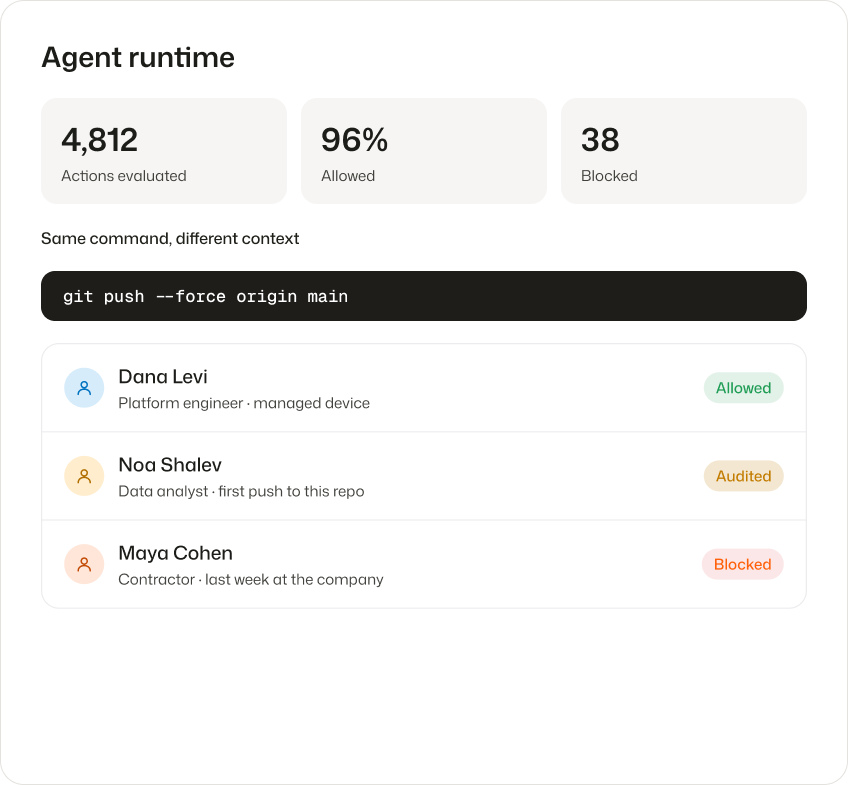
Glow evaluates each action in context: who is running the agent, their role and employment status, the repository and device it runs on, and what the session has already done. The same command can be allowed for a platform engineer and blocked for a citizen developer in her last week with the company.
Emergency kill switch and tamper-resistant guardrails
A blocked agent may try another route to the same outcome, or try to switch off the control itself. Glow blocks each attempt, and its guardrails resist modification, even with local admin rights. In a security incident, the emergency kill switch shuts AI activity down at the level you choose: one session, one user or the whole tenant.
Steer the agent, ask the human
When an action is risky, Glow explains why and offers a safer option, and the agent adjusts. When a decision belongs to a person, Glow holds the action and requests approval from the user or a designated approver, in the tool or in Slack.
Rules that write and tune themselves
From day one, Glow analyzes your own agent sessions and recommends rules, each with the activity it would have affected in the last month. When an analyst marks a false positive, Glow refines the rule.
Session-aware AI data loss prevention
Glow keeps track of what a session has accessed and applies that context to later actions. An agent that read customer records earlier in a session is prevented from sending its work to a public destination later.
Decide which AI your people use
Shadow AI eliminated for good
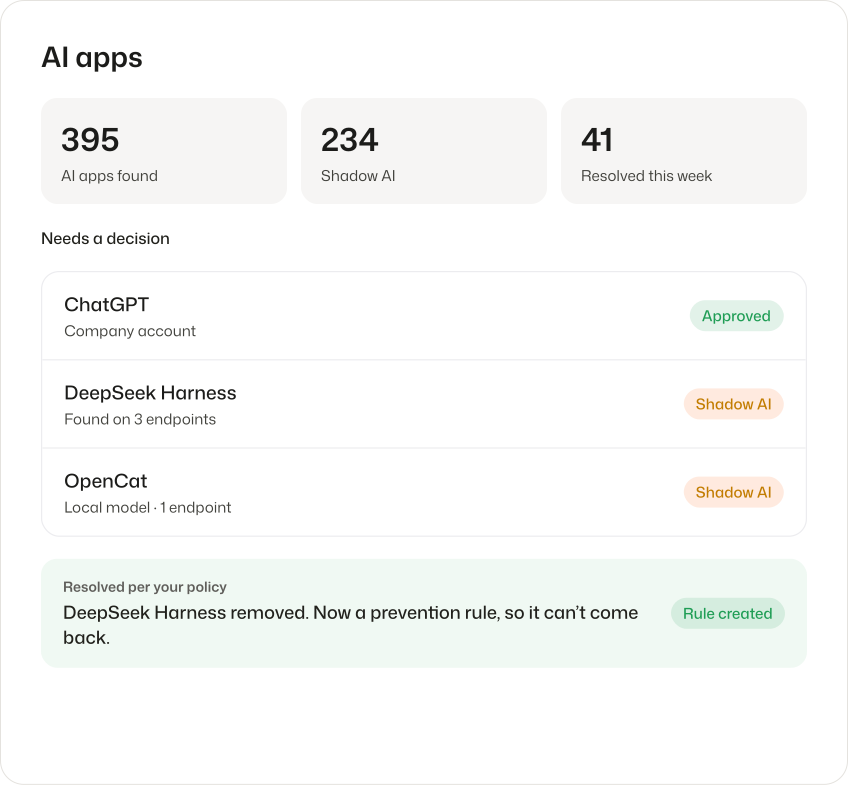
Glow analyzes every application on every endpoint and identifies the AI among them, including apps that no list of known AI covers. It finds shadow AI at four layers: the tool, the account, the route its traffic takes and the model it calls. Each case is resolved according to your policy, and each decision becomes a prevention rule, so what was eliminated does not come back.
Ensure all agents use your AI gateway
Glow finds every agent whose model traffic goes around your AI gateway and routes it through the gateway. A new session that starts on another route is stopped before the first prompt and pointed to the gateway.
AI security posture management
Glow checks AI tool settings against a hardening baseline. When a developer, a repository file or the agent itself weakens a setting, Glow restores the approved configuration and records the source of the change.
Unwanted MCPs, skills and plugins blocked
Glow blocks MCP servers, skills and plugins that your organization has not approved, in every agent and editor it covers. When an approved alternative exists, Glow names it, and the agent switches and completes the task.
AI acceptable use policy enforcement
Upload your existing AI acceptable use policy. Glow translates it into controls for applications, accounts, gateways, MCP servers and runtime rules, and shows what each control would have affected over the last 14 days.
Decide what software gets in
Keep out compromised plugins and packages
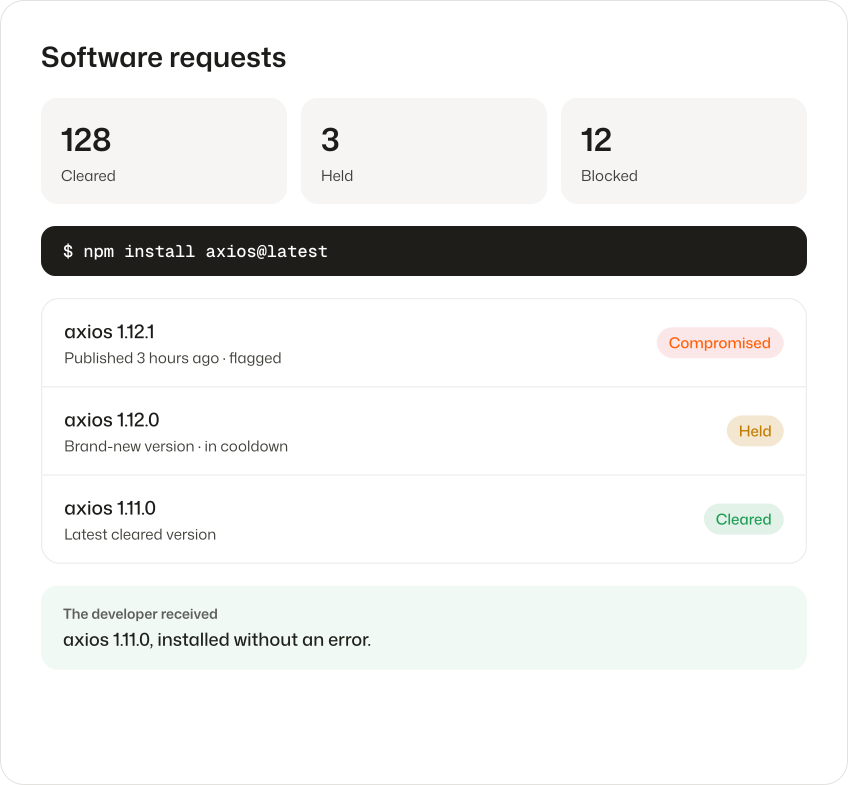
Glow checks packages, plugins and extensions at one control point that works through your existing SASE, whether a person or an agent requests them. Compromised and brand-new versions are kept out, and the requester receives the latest cleared version instead of an error.
Pre-execution analysis of skills and MCP servers
A Glow analysis agent reviews new skills, MCP servers, plugins and packages and compares what each one does with what it claims to do. It flags hidden instructions, credential access and undisclosed data egress, and it reviews every new version.
AI-powered allowlisting: Default-deny made easy
Glow builds and maintains the allowlist for you. Its agents vet the software already in use, decide what your policy can decide, and ask the right owner about the rest. Once default deny is on, new software is held, vetted in minutes and approved for the group that needs it.
Human-on-the-loop automated remediation
Glow remediates on its own within the guardrails you set, while a person watches each step and can pause it or roll it back. When a widely used package is reported as compromised, Glow blocks new installs, removes the package from every endpoint, revokes the credentials it could reach and pauses the affected agents.
Attack surface reduction
Glow identifies software that is unused, end of life or exploitable on devices with a path to critical assets. It then removes or updates that software, prioritized by exposure.
Frequently asked questions
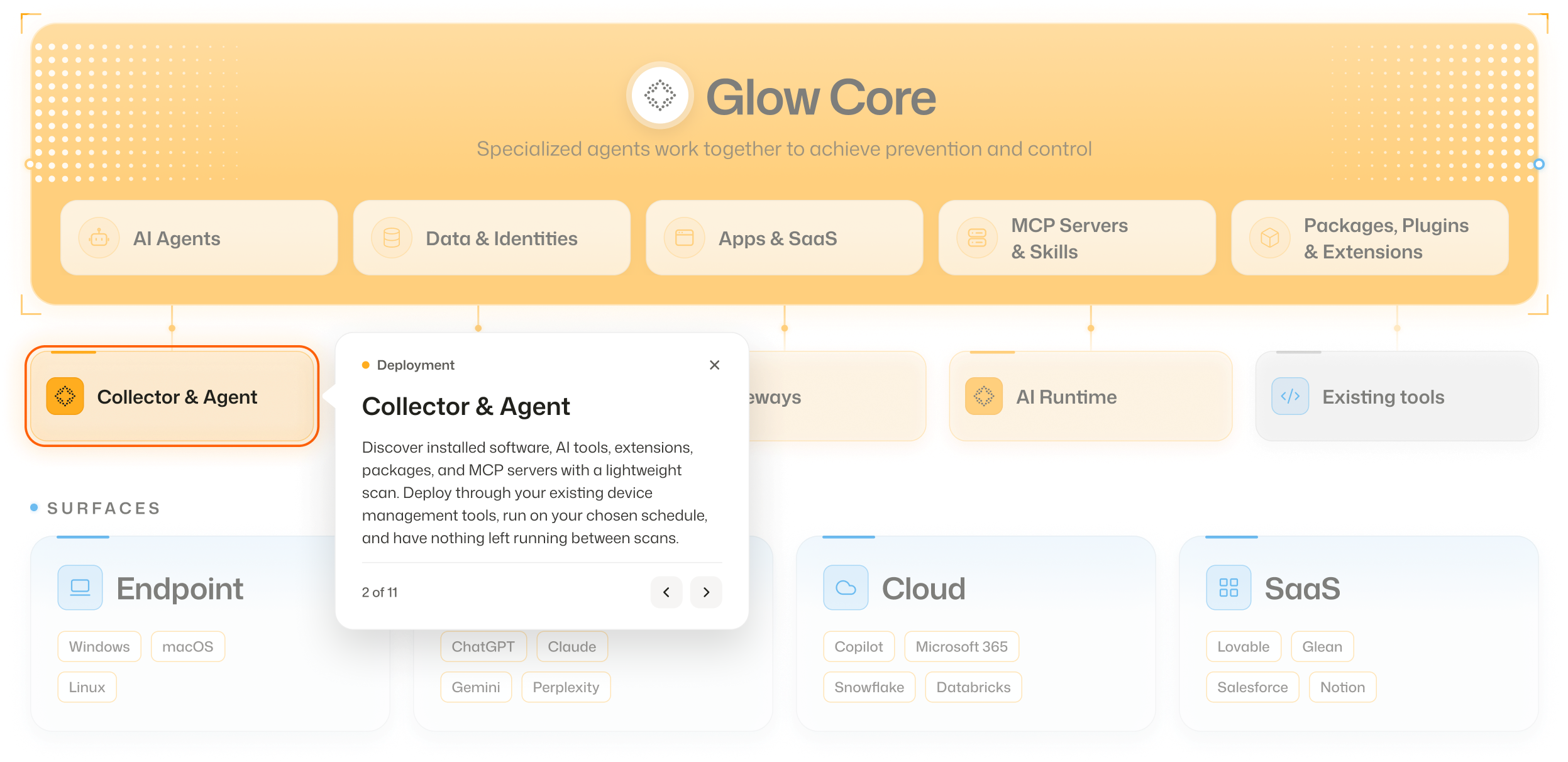
No. Glow reads from the tools you already own, and the Glow Collector scans each endpoint and shuts down. Runtime control works through hooks in the coding agents themselves. The Glow Agent is there for when you want Glow to decide what software can install and run.
Under ten minutes. You connect the tools you already run, push the Collector and the browser extension through your MDM, and turn on hooks from Glow. No PAC files are required.
No. Runtime control is transparent to the person using the agent unless an action is blocked.
Inside the agent, in the browser, on the endpoint and through the gateways you already run. Runtime rules are decided on the device, so they hold when it is offline.
Coding agents, desktop AI apps, AI in the browser, SaaS agent platforms and cloud agents. Glow analyzes all your software, so it also covers the AI that is on nobody’s list.
Yes. Every finding in Glow can be acted on, and Glow tracks each one to closure. A person approves the plan before anything changes, and any remediation action can be rolled back.
No. Glow works with them. It reads from your EDR and MDM, and it enforces download rules and model-traffic rules through the SASE and the AI gateway you already run.
Roles decide who can view and who can change each area, and people sign in through your SSO. Glow records every admin action, including each time someone opens an AI transcript.
Glow runs on Amazon Web Services and keeps customer data in the United States. Secrets are stripped before anything leaves the device.